
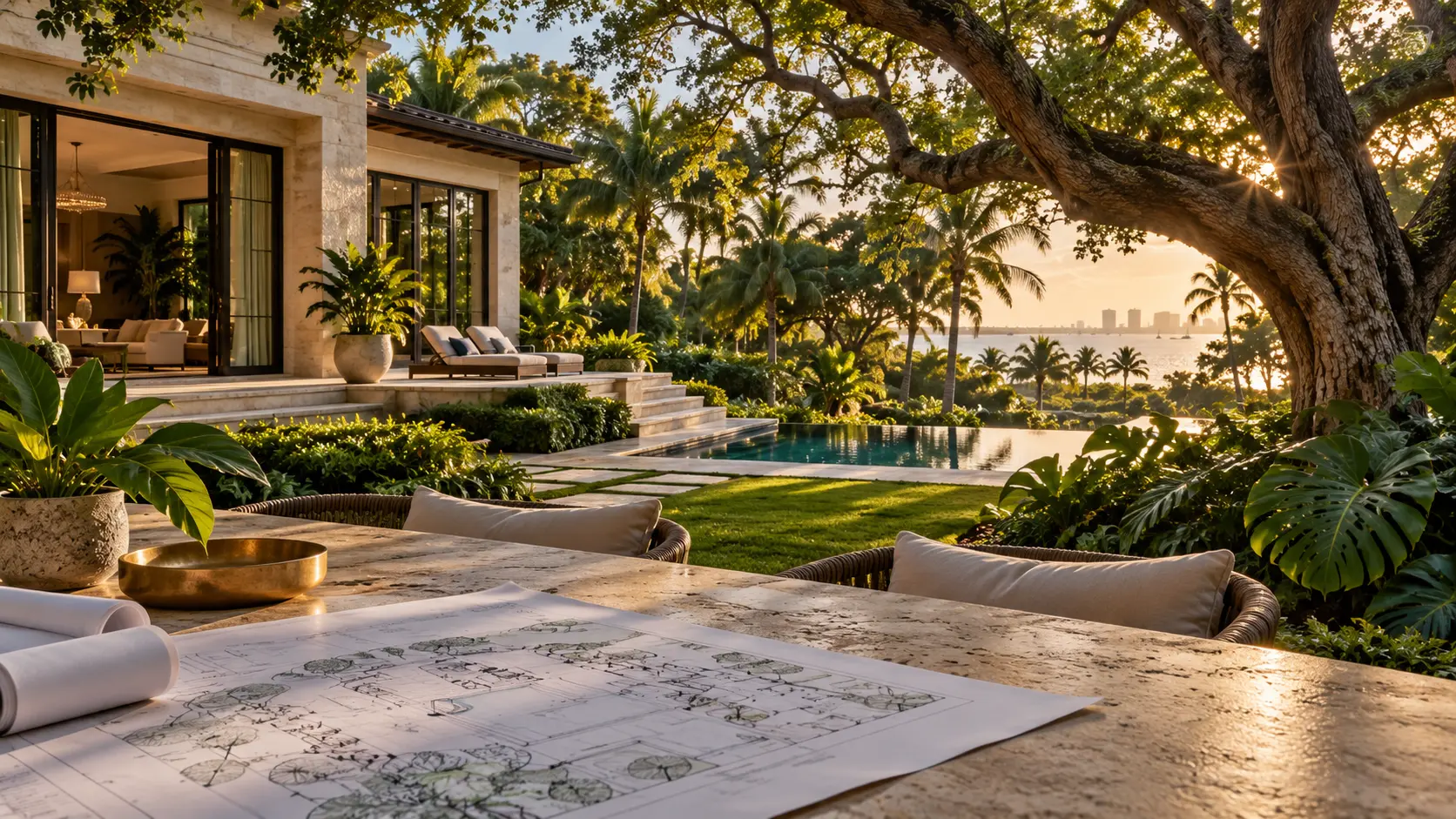
 Conceptual Coconut Grove-inspired garden residence; not a photograph of a specific home or listing.
The direct answer
Before presenting a Coconut Grove home's garden or expansion potential, assemble the tree survey or arborist information, available landscape and tree permits, pool and patio approvals, current property survey and maintenance records. Market the experience buyers can see today, then make any claims about removal, pruning, expansion or new construction contingent on current city review. A mature canopy can be a defining asset without being a blank check for future work.
What makes Coconut Grove different
The City of Miami publishes tree-permit guidance and says pruning more than 25 percent of a tree's canopy, crown or living foliage within a year requires a permit. Its standalone permit process describes survey, plan and photo or arborist materials. These are city rules and process descriptions, not a determination about an individual tree. Grove buyers often value shade and privacy, yet two similarly landscaped parcels can differ in root zones, drainage, setbacks and permitted outdoor improvements.
Build the address-specific file
Reconcile the survey with the house, pool, terraces, walls, landscape structures and visible trees. Gather prior permits and plans, drainage or irrigation work, tree-care invoices and any arborist reports. If a past improvement lacks clear records, resolve the discrepancy before photography and pricing. A seller may also commission a qualified arborist or contractor to explain condition, but should avoid guaranteeing that a buyer can remove a tree or enlarge the home.
- Document trees, landscape work and any pruning or removal permits
- Match pool, terrace and outdoor structures to plans and permits
- Clarify drainage and maintenance history
- Describe future potential only after current city review
Todd’s interpretation
Todd's interpretation is that a Coconut Grove home's canopy is part of its luxury identity, while clean documentation is part of its marketability. Well-prepared records let the marketing celebrate privacy and outdoor living without turning uncertain renovation possibilities into promises. That can reduce buyer hesitation during inspections and contract review.
A Local’s Guide
What daily life in Coconut Grove actually feels like
Coconut Grove blends tropical single-family streets, bayfront parks, sailing culture and an increasingly polished village center.
The Grove is a bayfront rather than beach neighborhood; its water life centers on parks, sailing and marinas, with Key Biscayne beaches nearby.
Peacock Park, The Barnacle, David T. Kennedy Park and The Kampong reflect the neighborhood’s mature landscape and bayfront identity.
Ariete, Los Félix, Amal and Bayshore Club are notable choices, with CocoWalk and Main Highway supporting a walkable restaurant circuit.
Dinner Key Marina, Regatta Harbour, Grove Harbour Marina and Biscayne Bay sailing clubs make this one of Miami’s most active boating neighborhoods.
The Biltmore course in Coral Gables and Crandon Golf on Key Biscayne are the closest major options.
CocoWalk, Commodore Plaza and Main Highway offer boutiques, restaurants and services in a compact village setting.
Questions Clients Ask
Frequently asked questions
Can a seller promise that a large tree may be removed?
No. City rules and an address-specific permit review govern tree work; obtain qualified guidance before making that claim.
Does a finished patio prove it was permitted?
No. Compare visible improvements with the survey, plans and city permit history.
Should an arborist report be part of every sale?
Not automatically. It can be useful where tree condition or proposed work is material; the need depends on the property.
Why share landscape records before a buyer asks?
Clear records help buyers understand maintenance, approvals and the limits of future plans, which can reduce uncertainty during diligence.